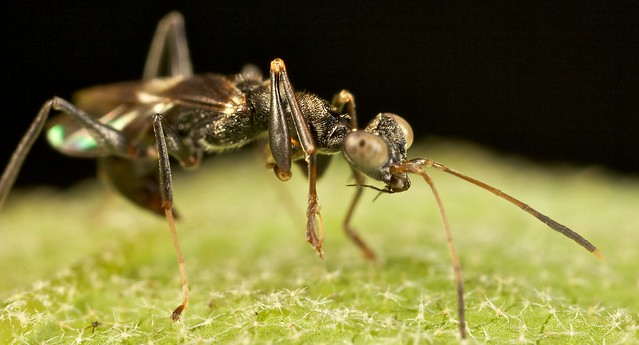
A blog about anything related to real and fictional insects (including other arthropods) and their impact, role and representation in society, media and pop culture.
Our planet is teeming with life, from the smallest microorganisms to the
gigantic whales inhabiting the oceans. Provided with millions of years
and a favourable enviornment, evolution has produced incredible and
often bizzare organisms that look more like a product of science fiction
than a real part of the nature we claim to know and understand.
I
would like to introduce to you a creature that has captured my interest
since early childhood, a creature that still holds mysteries that even
the brightest minds can only wish to unravel. Usually no bigger than a
few millimeters, this creature has succeeded into acomplishing tasks
that most would consider impossible or higly unlikely. This animal is
known as parasitoid wasps.
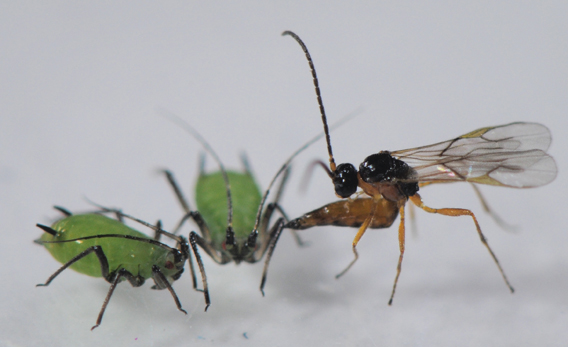
Ovipositing in an aphid.
But wat is a parasitoid? Is it a
parasite? Well not quite, a parasitoid is a creature that spends a
significant portion of it's life cycle on or inside a certain host and
unlike most parasites it eventually kills and usually consumes it's
host.
Many organisms are parasitoids but some arthropods,
especially insects, have reached astonishing feats as parasitoids. One
specific group of animals have become the experts in this field. Most
people think of wasps as social animals quite similar to bees but the
fact is that the majority of wasps are solitary creatures that
parasitise on other animals. Usually they are so small that are
unnoticable with the naked eye. So what can be so fascinating about
these little wasps?
First of all their life cycle is worthy of a horror movie.
The
adult wasp finds it's host by different means depending on the species,
in some cases the plants that are attacked by a caterpillar release
chemicals that attract the exact species that use the caterpillar as a
host! What follows is the wasp inserting it's ovipositor into the host
and injecting it's eggs inside it.
As seen here:
Usually the host’s immune system should be enough to irradicate the eggs
but the wasp has yet another amazing trick, polydnavirus!
In a few words, millions of years ago parasitoid wasps assimilated a
virus to use against their host’s immune system, keeping the eggs
intact.
The next step of their life cycle is simple, the eggs hatch
and the newly born larvae start to feed on their host’s fluids and
non-vital organs keeping it alive throughout the whole process until the
time they have to break out.
This video shows that stage of their development:
As you may have noticed after watching the video, in some cases the host
remains alive after the wasp larvae leave it’s body. Here is where the
most amazing ability of the parasitoid wasps can be seen! The heavily
injured host protects the same larvae that fed on it’s organs and
eventually broke out. Recent research has shown that one or two larvae
remain inside the host controlling it into protecting the rest of the
larvae, how this is achieved and how it is decided on which larvae to
stay inside is still uknown.
Another video that shows the zombified host being controlled by the wasp larvae:
Truly remarkable creatures!
Fairyfly, the smallest known insect.
The tiniest known insect to man is
also a parasitoid wasp that parasitises other insects eggs. They are
0.139 mm (139 μm) in length and posses a fully functional brain capable
of complex processing.
There are also species of parasitoid wasps that
parasitise on spiders making them create a chaotic web rather than the
well-organised web we are used to expect.
And ofcourse the more known jewel wasp that is famous for it’s ability to sting inside
the cockroach’s brain in the precise point to turn it into a helpless
slave that is later dragged by the antennae inside a nest where it will
provide food for the wasp’s young.
A comic explaining the jewel wasp's life cycle.
The young jewel wasp emerging from her cockroach host.
Really I can go all day and
night writing and talking about how amazing parasitoid wasps are and if
you don’t think the same way after reading the facts then don’t expect
anything in nature to ever surprise you more than this.
I thank
those who had the patience to read all the information and watch the
videos I had to provide. I really hope you enjoyed it and that it opened
your eyes to a world where the impossible is often proved possible by
the most unnoticable and truly alien creatures.
Bonus material:
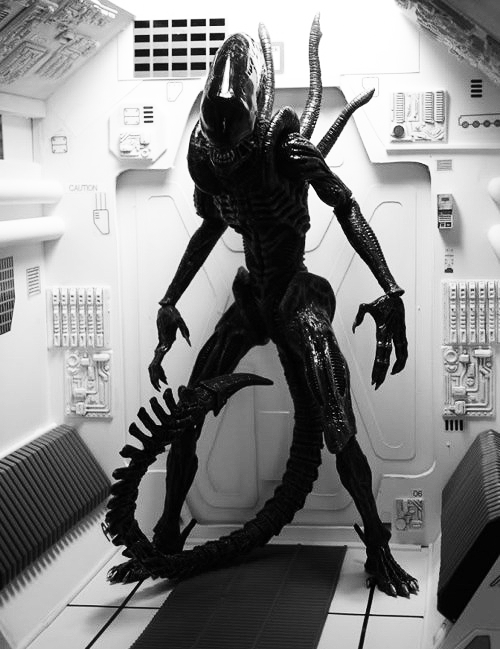
The Xenomorph standing upwards.
If it hasn’t crossed your mind until now the life
cycle of the famous Xenomorph creatures from the Alien series is
inspired by parasitoid wasps as well as other insects. This analysis provides enough information on the subject coming from the actual creators of the Alien concept.
Bonus video:
I came across a really detailed video of parasitoid wasps emerging from their unfortunate host that I would like to share.
I must warn you it’s really not for the faint of heart!